Google and Xcel’s 100‑Hour Iron‑Air Battery Deal: A Turning Point for Long‑Duration Storage in the AI Data Center Era
A 1.9GW clean buildout paired with a 30GWh iron‑air system shows how AI-driven load growth is pulling multi‑day storage into mainstream power planning.
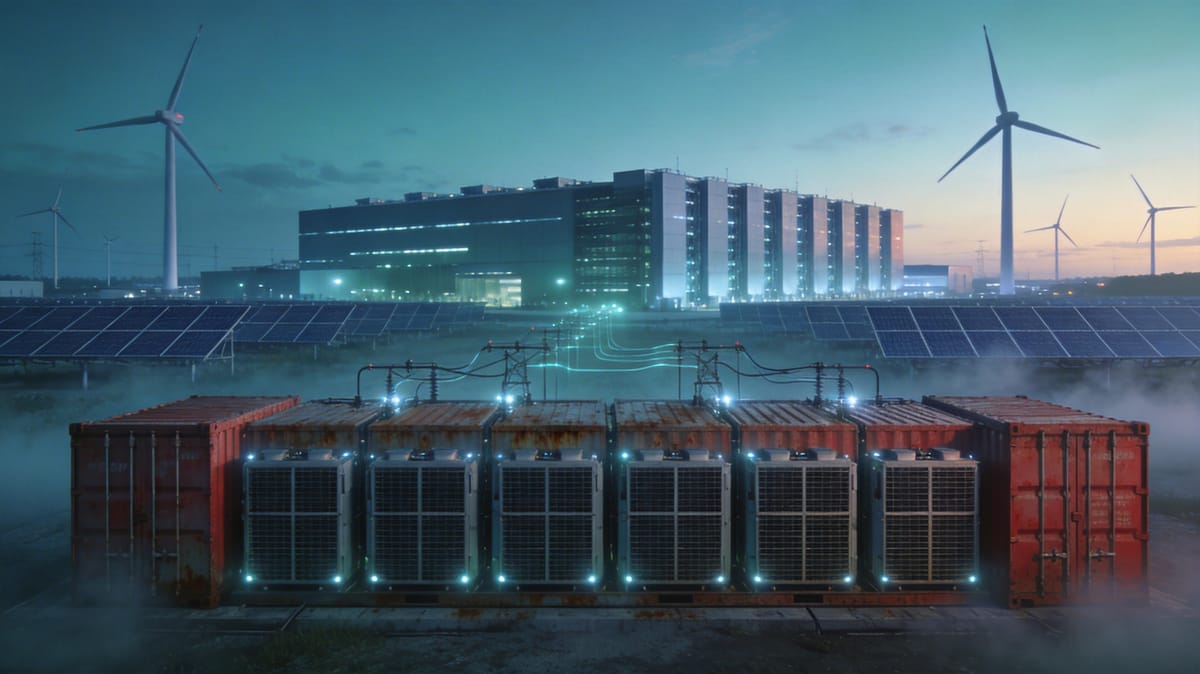
As AI pushes data center load to a new scale, the hardest grid question is no longer simply how to buy more renewable electricity. The question is how to turn intermittent wind and solar into power that can be contracted, scheduled, and defended in front of regulators without triggering reliability concerns or cost blowback from existing ratepayers. That is why the electric service agreement between Xcel Energy and Google for a new data center in Pine Island, Minnesota is worth reading as a new-energy signal, not just a corporate expansion story.
Xcel Energy says the agreement is designed to bring roughly 1,900 megawatts of new clean energy to the grid, including 1,400 MW of wind, 200 MW of solar, and 300 MW of long-duration energy storage. The standout element is the storage technology and scale. Xcel states that the clean resources funded through the agreement include a 300 MW, 30 gigawatt-hour Form Energy iron-air battery system, described as the largest battery project by energy capacity announced to date globally. The battery is framed as a 100-hour system that can store energy during periods of high production and low demand and dispatch it during periods of high demand, providing firm capacity over multiple days.
Those numbers matter because the mainstream grid storage market has largely been built on lithium-ion systems optimized for short-duration use, often in the 4–8 hour range. Short-duration batteries are excellent for intra-day shifting, peak shaving, frequency services, and fast response. But they become economically challenging when the risk window is not hours but days. Multi-day weather events, prolonged low renewable output, or grid stress during heat waves and cold snaps are precisely the scenarios where an electricity system has traditionally leaned on gas peakers and other fossil backup resources. A 100-hour storage block is not a small upgrade; it represents a different class of reliability asset.
The Minnesota deal is also notable because it explicitly addresses the political economy of data center growth. In many regions, the backlash is not about the existence of hyperscale facilities but about who pays for grid upgrades and whether adding large loads slows decarbonization. Xcel’s announcement emphasizes that Google will pay all costs for its new service consistent with state requirements for large loads, and that Google will also cover new grid infrastructure costs associated with the project. The agreement is expected to be filed with the Minnesota Public Utilities Commission for review and must be formally approved.
In parallel, Xcel describes a Clean Energy Accelerator Charge mechanism that will provide for the 1,400 MW of wind, 200 MW of solar, and 300 MW of long-duration storage, along with a $50 million investment from Google toward Xcel’s Capacity Connect program intended to support grid reliability. Structurally, the approach aims to separate incremental costs driven by the new load from the broader base of existing customers, while tying the load growth to new carbon-free supply additions.
From the perspective of the clean energy transition, this is a sign that corporate renewable procurement is maturing. The older model focused on renewable energy credits, annual energy matching, and power purchase agreements that primarily optimized for “green share.” But high-density, always-on data center loads force the conversation into system operations: capacity, reserves, congestion, and grid resilience. Long-duration storage becomes a key piece because it is one of the few tools that can convert variable generation into multi-day deliverability without defaulting to fossil capacity.
Why iron-air appears in this type of deal is also instructive. Iron-air systems are not competing with EV batteries on energy density. Their bet is cost and duration for grid applications. The product logic is closer to “electrochemical multi-day storage” aimed at covering the expensive tail of reliability risk that short-duration batteries cannot economically address. By placing a 30 GWh iron-air system inside the supply package for an AI-era data center, Google and Xcel are effectively using an extreme-load customer to validate long-duration storage as a bankable component of clean power planning.
A useful way to interpret the project is to focus less on 300 MW and more on 30 GWh. Power capacity tells you how quickly a battery can discharge; energy capacity tells you how long the system can sustain output. A step-change in energy capacity opens different operational options. In principle, it can support multi-day load events, smooth extended renewable droughts, reduce curtailment during surplus production, and shift how planners value dispatchable resources. For grid operators, it is the difference between “a fast tool for evening peaks” and “a resource that can ride through prolonged stress periods.”
That said, long-duration storage is not automatically a solved problem. Scaling it requires clearing several hard hurdles.
The first is economics and financeability. Multi-day storage is capital intensive and its payback depends heavily on capacity value and avoided reliability costs, not just arbitrage between low and high power prices. That is why rate design and regulatory frameworks matter. In this deal, the large-load customer is positioned to pay for the incremental reliability asset, while the agreement is placed under commission review to convert the structure into enforceable, audited terms.
The second is interconnection and transmission reality. Adding 1.9 GW of new clean resources is not simply a construction checklist. It implies siting, grid upgrades, and regional constraints. In many markets, the bottleneck for renewables is not willingness to invest, but the ability to interconnect and deliver power through constrained transmission corridors. Long-duration storage can mitigate some congestion, but it does not replace the need for transmission planning.
The third is operational performance at scale. A “100-hour battery” must prove that duration and availability across temperature ranges, cycling strategies, maintenance regimes, and extreme weather conditions. For grids, predictable deliverability and availability are often more valuable than peak headline specs. For data center customers, the question is whether the combination can be translated into auditable reliability and carbon-free energy metrics that stand up to scrutiny.
The fourth is policy replication. If regulators accept a model where a hyperscale load funds a tailored clean supply and multi-day storage package through a dedicated charge mechanism, other utilities and other states may treat it as a template. That would shift corporate clean energy procurement from “buying renewables” toward “buying renewables plus deliverability.” In turn, that could reshape how projects are financed and priced, and accelerate the commercialization race among long-duration storage technologies.
Seen this way, the Minnesota agreement is a marker of where new energy is heading under AI load growth. Short-duration lithium-ion storage has already moved from niche to mainstream. The next fight is whether multi-day storage can earn its own mainstream asset class status. When a major corporate buyer is willing to embed long-duration storage into a regulated service agreement and pay for the associated system buildout, long-duration storage stops being a pilot story and becomes part of the utility planning toolbox.
The most important follow-up will not be another headline number, but how the agreement lands in regulatory review and what operational commitments are ultimately made. Long-duration storage will scale when its value can be priced clearly in markets and regulation. This deal pulls that debate out of abstract technology forecasts and into the language that matters most for deployment: contracts, tariffs, and commission approvals.
Source: Xcel Energy Newsroom, Electrek